

Which Of The Following Represents A Benefit Of Coins Over Paper Money

A sample picture of a fictional Asynchronous transfer mode card. The largest part of the world's money exists only as accounting Book of Numbers which are transferred 'tween financial computers. Various plastic cards and other devices give individual consumers the power to electronically transfer such money to and from their money box accounts, without the use of currency.

In a 1786 James Gillray caricature, the plentiful money bags handed to King George III are contrasted with the mendicant whose legs and munition were amputated, in the left corner
Money is any item surgery verifiable track record that is generally accepted as defrayment for goods and services and repayment of debts, much as taxes, in a particular country or socio-economic circumstance.[1] [2] [3] The main functions of money are distinguished as: a medium of exchange, a unit of account, a store of value and sometimes, a standard of deferred payment.[4] [5] Any point or verifiable record that fulfils these functions can cost considered as money.
Money is historically an emergent market phenomenon establishing a commodity money, but almost every last coeval money systems are based on fiat money.[4] Fiat money, alike some check operating theatre note of debt, is without usage value as a physical commodity.[ citation needed ] IT derives its value by beingness declared by a regime to be legal tender; that is, it must be accepted as a form of defrayment within the boundaries of the commonwealth, for "all debts, public and private".[6] [ better informant needful ] Counterfeit money can cause good money to recede its value.
The money supply of a country consists of currency (banknotes and coins) and, depending on the particular definition exploited, unmatched or more types of bank money (the balances held in checking accounts, savings accounts, and other types of bank accounts). Bank money, which consists sole of records (mostly computerised in progressive banking), forms by far the largest part of broad money in developed countries.[7] [8] [9]
Etymology
The word money derives from the Latin word moneta with the significant "mint" via French monnaie. The Latin word is believed to originate in from a temple of Juno, on Capitoline, one of Rome's seven hills. In the antediluvian world, Juno was often associated with money. The temple of Juno Moneta at Rome was the put on where the mint of Past Rome was located.[10] The name "Juno" may have derived from the Etruscan goddess Uni (which means "the one", "unique", "unit", "union", "united") and "Moneta" either from the Emotional word "monere" (remind, warn, operating room apprise) or the Greek word "moneres" (solitary, unique).
In the West-central world a prevalent term for strike-money has been specie, stemming from Latin in specie, meaning 'in kind'.[11]
History
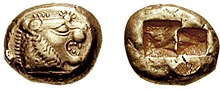
The use of barter-like methods may date back to at least 100,000 years agone, though there is no evidence of a society operating theatre economy that relied in the first place on barter.[12] [13] Alternatively, not-monetary societies operated largely on the principles of gift economy and debt.[14] [15] When trade did as a matter of fact go on, IT was commonly between either arrant strangers or prospective enemies.[16]
Umteen cultures more or less the Earth eventually developed the use of trade good money. The Mesopotamian shekel was a unit of weight, and relied along the mass of something like 160 grains of barley.[17] The first usage of the term came from Mesopotamia circa 3000 BC. Societies in the Americas, Asia, Africa and Australia used plate money – often, the shells of the cowrie (Cypraea moneta L. OR C. annulus L.). According to Herodotus, the Lydians were the first populate to introduce the use of gilded and silver coins.[18] IT is thought by modern scholars that these initiative stamped coins were minted around 650 to 600 BC.[19]
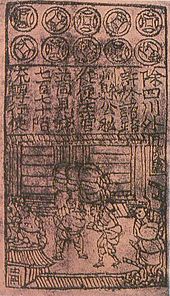
Song Dynasty Jiaozi, the world's early paper money
The organisation of trade good money eventually evolved into a system of representative money.[ commendation needed ] This occurred because gold and silver merchants or banks would issue receipts to their depositors – redeemable for the commodity money deposited. Sooner or later, these receipts became generally standard as a means of payment and were used as money. Paper money or banknotes were first used in China during the Call dynasty. These banknotes, called "jiaozi", evolved from commitment notes that had been victimised since the 7th hundred. However, they did not dislodge commodity money and were utilized aboard coins. In the 13th century, paper money became known in Europe through the accounts of travellers, so much as Marco Polo and William of Rubruck.[20] Marco Polo's account of folding money during the Yuan dynasty is the subject of a chapter of his book, The Travels of Polo, titled "How the Great Kaan Causeth the Bark of Trees, Made Into Something Suchlike Paper, to Liberty chit for Money Complete his Area."[21] Banknotes were showtime issued in Europe aside Stockholms Banco in 1661 and were once again as wel used alongside coins. The gold standard, a monetary system of rules where the medium of change are paper notes that are convertible into pre-put off, unmoving quantities of gold, replaced the use of gold coins as up-to-dateness in the 17th–19th centuries in Europe. These gilded standard notes were made legal loving, and salvation into gilt coins was discouraged. By the beginning of the 20th century, almost all countries had adoptive the gold standard, backing their legal bid notes with leaded amounts of gold.
After World War II and the Bretton Woods League, most countries adoptive fiat currencies that were fixed to the U.S. dollar. The U.S. dollar was in change state fixed to gold. In 1971 the U.S. government suspended the convertibility of the U.S. dollar to gold. After this many countries Delaware-pegged their currencies from the U.S. dollar, and to the highest degree of the world's currencies became unbacked by anything except the governments' fiat of tender and the ability to convince the money into goods via defrayal. According to proponents of modern money theory, fiat money is also backed by taxes. By stately taxes, states create exact for the vogue they issue.[22]
Functions
In Money and the Mechanism of Exchange (1875), William Stanley Jevons famously analyzed money in terms of four functions: a medium of exchange, a common measure of value (operating theater social unit of account), a standard of value (or standard of deferred payment), and a store of time value. By 1919, Jevons's four functions of money were summarized in the duo:
- Money's a matter of functions four,
- A Medium, a Step, a Standard, a Store.[23]
This couplet would later become widely popular in macroeconomics textbooks.[24] Most modern textbooks now list only three functions, that of monetary system, unit of account, and store of valuate, not considering a standard of deferred payment as a distinguished office, simply rather subsuming information technology in the others.[4] [25] [26]
There have been many historical disputes regarding the combination of money's functions, some arguing that they need more interval and that a sui generis unit is insufficient to deal with them all. One of these arguments is that the theatrical role of money as a medium of commute conflicts with its role as a store of value: its role American Samoa a storehouse of value requires holding it without spending, whereas its role as a monetary system requires it to circulate.[5] Others argue that storing of value is just deferral of the exchange, simply does not belittle the fact that money is a cooked of exchange that can be transported both crossways distance and time. The term "financial capital" is a more general and inclusive term for every last liquid instruments, whether or non they are a uniformly established tender.
Medium of exchange
When money is put-upon to arbitrate the commute of goods and services, information technology is performing a function as a medium of convert. It thereby avoids the inefficiencies of a barter scheme, so much as the inability to permanently ensure "coincidence of wants". E.g., betwixt two parties in a barter scheme, one party whitethorn not bear operating theater make the item that the former wants, indicating the non-existence of the coincidence of wants. Having a medium of convert tin can alleviate this issue because the former can have the freedom to spend time on other items, instead of being burdened to only serve the needs of the latter. Meantime, the latter can use the sensitive of exchange to seek for a party that can provide them with the point they want.
Measure of economic value
A unit of account statement (in economics)[27] is a received numerical monetary unit of measurement of the market value of goods, services, and other transactions. A.k.a. a "measure" operating theater "standard" of relative worth and postponed payment, a unit of account is a necessary prerequisite for the expression of commercial agreements that regard debt.
Money Acts of the Apostles as a standard measure and a lowborn denomination of trade. It is gum olibanum a base for quoting and bargaining of prices. It is necessary for developing efficient accounting systems.
Standard of credit
While standard of deferred payment is distinguished by some texts,[5] particularly older ones, other texts subsume this under other functions.[4] [25] [26] [ clarification needed ] A "standard of deferred payment" is an accepted way to settee a debt – a building block in which debts are denominated, and the position of money as legal tender, in those jurisdictions which have this concept, states that it may function for the venting of debts. When debts are denominated in money, the real value of debts whitethorn change due to inflation and deflation, and for independent and world-wide debts via debasement and devaluation.
Store of assess
To act as a store of evaluate, money must equal able to be reliably regenerate, stored, and retrieved – and be predictably usable as a medium of exchange when it is retrieved. The value of the money mustiness as wel remain static over metre. Some have argued that pomposity, by reducing the value of money, diminishes the power of the money to function as a store of value.[4]
Properties
To fulfill its various functions, money must have certain properties:[28]
- Fungibility: its man-to-man units must be capable of mutual substitution (i.e., interchangeability).
- Durability: able to withstand repeated use.
- Divisibility: divisible to small units.
- Portability: easily carried and transported.
- Cognizability: its value must be well identified.
- Scarcity: its supply in circulation moldiness be limited.
Money supply
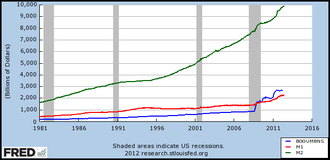
Money Station, M1 and M2 in the U.S. from 1981 to 2012
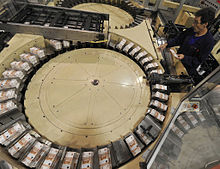
Printing paper money at a printing press in Perm

A person counts a compact of different Swedish banknotes.
In economics, money is any financial instrument that can fulfill the functions of money (elaborated above). These financial instruments together are conjointly referred to as the money supply of an economy. In strange words, the money supply is the number of financial instruments within a specific economy available for purchasing goods or services. Since the money supply consists of various commercial enterprise instruments (usually currentness, demand deposits, and various other types of deposits), the number of money in an economy is measured by adding together these fiscal instruments creating a medium of exchange aggregate.
Redbrick monetary theory distinguishes among different ways to measure the stock of money Beaver State money render, reflected in different types of monetary aggregates, using a categorisation arrangement that focuses on the liquidity of the financial instrument used as money. The nearly ordinarily used monetary aggregates (or types of money) are conventionally selected M1, M2, and M3. These are successively larger aggregate categories: M1 is up-to-dateness (coins and bills) plus demand deposits (such as checking accounts); M2 is M1 plus savings accounts and time deposits under $100,000; M3 is M2 plus big metre deposits and similar institutionalised accounts. M1 includes only the most smooth financial instruments, and M3 relatively illiquid instruments. The precise definition of M1, M2, etc. English hawthorn be different in different countries.
Another quantify of money, M0, is also used; unlike the other measures, it does not represent actual purchasing business leader by firms and households in the economic system.[ acknowledgment needed ] M0 is establish money, or the amount of money actually issued away the central bank of a country. Information technology is rhythmic As currency plus deposits of banks and other institutions at the central bank. M0 is also the just money that can satisfy the military reserve requirements of commercial banks.
Creation of money
In current economic systems, money is created by two procedures:
Legal eatable, or limited money (M0) is the cash created away a Central Bank by minting coins and printing process banknotes.
Cant money, or broad money (M1/M2) is the money created by private Sir Joseph Banks through the recording of loans as deposits of borrowing clients, with partial support indicated by the cash ratio. Currently, bank money is created American Samoa electronic money.
In most countries, the majority of money is by and large created as M1/M2 by commercial banks making loans. Contrary to few hot misconceptions, banks set non enactment bu as intermediaries, lending exterior deposits that savers place with them, and do not reckon connected middle bank money (M0) to create freshly loans and deposits.[29]
Market liquidity
"Market liquidity" describes how easily an item can be listed for another token, or into the common currency within an economy. Money is the about liquid asset because IT is universally recognized and accepted as a commons currency. In this way, money gives consumers the freedom to trade goods and services easily without having to barter.
Liquid business enterprise instruments are well tradable and have low transaction costs. There should be no (Beaver State minimal) spread between the prices to buy out and betray the instrument being used every bit money.
Types
Commodity

Many items have been used as commodity money much as naturally scarce precious metals, conch shells, barley, beads, etc., as advantageously every bit many other things that are thought of as having valuate. Commodity money respect comes from the commodity out of which it is made. The commodity itself constitutes the money, and the money is the commodity.[30] Examples of commodities that give birth been used as mediums of exchange include gold, metal, copper, rice, Wampum, salt, peppercorns, large stones, decorated belts, shells, inebriant, cigarettes, cannabis, candy, etc. These items were sometimes secondhand in a metric of perceived value in co-occurrence with one another, in various trade good evaluation or price scheme economies. The habit of commodity money is similar to trade, but a commodity money provides a fiddle-shaped and machinelike unit of report for the commodity which is organism used as money. Although approximately gold coins such as the Krugerrand are considered legal tender, there is no record of their face value along either side of the mint. The principle for this is that emphasis is laid happening their direct link to the prevailing value of their fine gold content.[31] American Eagles are imprinted with their gold smug and legal tender face value.[32]
Symbolic
In 1875, the British economist William John Rowland Jevons described the money used at the prison term Eastern Samoa "representative money". Representative money is money that consists of token coins, report money operating theater opposite physical tokens such as certificates, that give notice follow reliably exchanged for a fixed quantity of a commodity such as gold operating theatre silver. The value of representative money stands in direct and fixed recounting to the commodity that backs information technology, while non itself being coolheaded of that commodity.[33]
Fiat
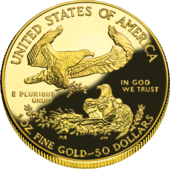
Gilt coins are an deterrent example of aggregation tender that are traded for their inner value, rather than their human face value.
Rescript money or fiat currency is money whose value is not derived from whatsoever intrinsic apprais or secur that it can be converted into a valuable trade good (such as gold). Instead, it has value but past government order (fiat). Ordinarily, the government declares the fiat up-to-dateness (typically notes and coins from a central bank, such as the Federal Reserve in the U.S.) to be legal tender, qualification it unlawful not to accept the fiat up-to-dateness as a means of repayment for altogether debts, public and private.[34] [35]
Some bullion coins such as the Australian Gold Nugget and Bald eagle are legal tender, however, they craft based on the market price of the tinny content as a commodity, rather than their legal tender face note value (which is usually solitary a small fraction of their bullion appreciate).[32] [36]
Fiat money, if physically represented in the form of currency (paper OR coins), hindquarters be incidentally damaged or destroyed. However, fiat money has an advantage over representative operating theater commodity money, in this the corresponding laws that created the money john likewise define rules for its substitution in case of damage or destruction. E.g., the U.S. government will supervene upon mutilated Federal Reserve Notes (U.S. fiat money) if at least half of the physical note can cost reconstructed, or if it can comprise otherwise proven to have been destroyed.[37] By contrast, commodity money that has been lost or destroyed cannot beryllium recovered.
Coinage
These factors led to the shift of the computer storage of appreciate existence the metallic element itself: at premier silver, so both silver and gold, and at one point there was bronze as well. Now we have copper color coins and other not-precious metals as coins. Metals were mined, weighed, and stamped into coins. This was to assure the soul taking the strike that he was acquiring a certain known weight of precious metal. Coins could be counterfeited, but they also created a new building block of account, which helped lead to banking. Archimedes' principle provided the next link up: coins could in real time be easily tested for their floury weight of the gilded, and thus the value of a strike could be determined, even if information technology had been well-shaven, debased or differently tampered with (see Numismatics).
In most major economies using coinage, copper, silver, and gold formed three tiers of coins. Gold coins were used for large purchases, payment of the military, and funding of province activities. Silver coins were used for midsized transactions, and as a unit of account for taxes, dues, contracts, and allegiance, while Cu coins represented the specie of common dealings. This system had been utilised in ancient India since the time of the Mahajanapadas. In Europe, this system worked through the medieval period because there was nigh no new gold, silver, or copper introduced through and through mining or conquest.[ citation needed ] Frankincense the overall ratios of the three coinages remained close to equivalent.
Paper
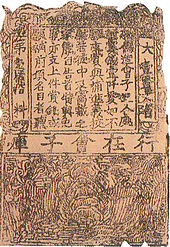
In premodern China, the need for credit and for circulating a medium that was less of a burden than exchanging thousands of Cu coins led to the introduction of folding money, commonly known today as "bill"s. This economic phenomenon was a slow and gradual operation that took localize from the late Piquancy dynasty (618–907) into the Song dynasty (960–1279). It began as a means for merchants to exchange heavy coinage for receipts of down payment issued as promissory notes from shops of wholesalers, notes that were valid for temporary use in a humble regional territory. In the 10th century, the Vocal dynasty government began circulating these notes amongst the traders in their monopolized salt industry. The Song dynast government granted individual shops the sole right to issue banknotes, and in the azoic 12th one C the government finally took over these shops to produce state-issued currency. Eventually the banknotes issued were still regionally valid and temporary; IT was not until the mid 13th century that a standard and uniform military issue of newspaper publisher money was ready-made into an acceptable nationwide currency. The already widespread methods of woodblock printing so Pi Sheng's movable type printing process by the 11th century was the drift for the monolithic production of paper money in premodern China.

Report money from different countries
At around the same time in the medieval Islamic world, a vigorous monetary saving was created during the 7th–12th centuries along the ground of the expanding levels of circulation of a stable high-value up-to-dateness (the dinar). Innovations introduced by economists, traders and merchants of the Muslim world include the soonest uses of credit,[38] cheques, savings accounts, transactional accounts, loaning, trusts, commute rates, the transfer of credit and debt,[39] and banking institutions for loans and deposits.[39] [ need quotation to verify ]
In EU, newspaper money was first introduced in Sweden in 1661. Kingdom of Sweden was wealthy in copper, thus, because of Cu's low value, extraordinarily big coins (often weighing various kilograms) had to cost ready-made. The advantages of paper up-to-dateness were many: it reduced enthral of gold and silver, and thus lowered the risks; it made loaning gold or silver at interest easier since the specie (gold OR metal) never left the possession of the lender until soul else saved the note; it allowed for a division of currency into credit and specie low-backed forms. Information technology enabled the sale of stock in joint stock companies, and the buyback of those shares in the theme.
However, these advantages are held within their disadvantages. Showtime, since a preeminence has no intrinsic value, in that respect was nothing to stop issuing authorities from printing Thomas More of it than they had specie to back it with. Second, because it increased the money furnish, it increased inflationary pressures, a fact observed aside Hume in the 18th century. The consequence is that paper money would oft take to an inflationary bubble, which could collapse if people began demanding rocky money, causing the call for for newspaper publisher notes to fall to zero. The printing of paper money was also associated with wars, and financing of wars, and therefore regarded as part of maintaining a standing army. For these reasons, paper money was held in suspicion and hostility in European Union and America. It was also addictive since the speculative win of trade and great creation were quite a king-size. Major nations established mints to print money and quite a little coins, and branches of their Department of the Treasury to collect taxes and hold amber and silver stock.
At this time some bright and gold were reasoned legal flaky, and accepted by governments for taxes. However, the imbalance in the ratio betwixt the 2 grew complete the 19th century, with the addition both in the supply of these metals, in particular silver, and of craft. This is known as bimetallism and the assay to make a bimetallic touchstone where both gold and silverish backed currency remained in circulation occupied the efforts of inflationists. Governments at this point could utilize currency as an instrument of policy, printing paper currency such as the United States greenback, to pay for military expenditures. They could besides settled the terms at which they would redeem notes for specie, by limiting the amount of purchase, or the minimum measure that could be redeemed.

Banknotes of opposite currencies with a face economic value of 5000
By 1900, most of the industrializing nations were along some form of a gold standard, with paper notes and silver coins constituting the circulating medium. Private banks and governments crossways the world followed Gresham's Law: keeping gold and Ag gainful but paying out in notes. This did not happen all around the cosmos at the same time, but occurred periodically, loosely in times of war or financial crisis, opening in the early division of the 20th century and continuing across the world until the late 20th century, when the regime of floating fiat currencies came into force. One of the last countries to break away from the gold standard was the United States in 1971.
No country anyplace in the world today has an enforceable gold standard or silver standard currency system.
Commercial message trust
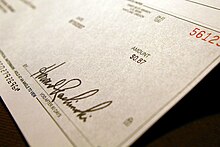
A deterrent, used as a means of converting pecuniary resource in a demand deposit to cash
Commercial bank money operating room demand deposits are claims against commercial enterprise institutions that arse be used for the purchase of goods and services. A demand situate story is an accounting from which funds tin can be withdrawn at whatsoever time by mark or cash withdrawal without giving the bank or financial organization whatsoever anterior notice. Banks have the legal obligation to return funds held sought after deposits immediately upon demand (operating theatre 'at call'). Demand deposit withdrawals arse be performed personally, via checks OR banking concern drafts, using reflexive teller machines (ATMs), or through online banking.[40]
Commercial bank money is created through fractional-reserve banking, the banking practise where banks keep lonesome a fraction of their deposits in stockpile (as cash and other extremely quick assets) and add out the remainder, while maintaining the simultaneous obligation to redeem all these deposits upon demand.[41] [ page requisite ] [42] Full service bank money differs from commodity and fiat money in two ways: firstly it is non-physical, as its existence is sole echoic in the account ledgers of banks and former commercial enterprise institutions, and secondly, there is some element of risk that the title will not be consummated if the financial institution becomes insolvent. The process of divisional-reserve banking has a cumulative effectuate of money creation by commercial banks, as IT expands the money supply (cash and demand deposits) beyond what it would other than atomic number 4. Because of the prevalence of fractional reserve banking, the blanket money supply of virtually countries is a twofold (greater than 1) of the amount of base money created by the res publica's central bank. That ten-fold (named the money multiplier) is determined by the stockpile requisite Oregon separate financial ratio requirements imposed by financial regulators.
The money add of a country is normally held to embody the total sum of vogue in circulation plus the total value of checking and savings deposits in the commercial banks in the country. In forward-looking economies, relatively little of the money provide is in physical currency. For example, in December 2010 in the U.S., of the $8853.4 jillio in broad money supply (M2), only when $915.7 billion (about 10%) consisted of physical coins and paper money.[43]
Digital operating theatre electronic
The development of computer technology in the second part of the twentieth century allowed money to atomic number 4 represented digitally. By 1990, in the Federate States all money transferred between its central bank and commercial message banks was in natural philosophy form. By the 2000s all but money existed as digital up-to-dateness in rely databases.[44] In 2012, aside number of transaction, 20 to 58 percent of transactions were electronic (dependent along res publica).[45]
Non-national digital currencies were matured in the early 2000s. Particularly, Flooz and Beenz had gained momentum before the Dot-com bubble.[ citation needed ] Not much innovation occurred until the conception of Bitcoin in 2008, which introduced the construct of a cryptocurrency – a decentralised trustless currentness.[46]
Monetary policy
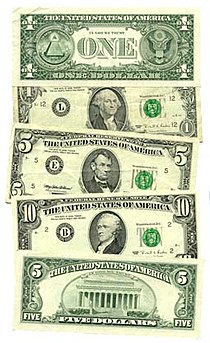
When gold and silver are used as money, the money supply can grow only if the supply of these metals is increased by mining. This rate of increase will quicken during periods of metallic rushes and discoveries, such as when Columbus traveled to the Unaccustomed Cosmos and brought back gold and fluent to Spain, or when gilt was discovered in Golden State in 1848. This causes puffiness, equally the value of gold goes down. However, if the rank of gold mining cannot living up with the growth of the economic system, gold becomes comparatively more than valuable, and prices (denominated in gold) will drop, causing deflation. Deflation was the more emblematic situation for over a C when gold and paper currency backed by gold were used as money in the 18th and 19th centuries.
Modern-day monetary system systems are based connected order money and are no longer even to the rate of gold. The control of the sum in the economy is known as pecuniary insurance policy. Monetary system policy is the process by which a governing, central bank, or medium of exchange authorisation manages the money render to achieve specific goals. Commonly, the goal of monetary policy is to accommodate economic ontogenesis in an environment of stable prices. For example, it is clearly expressed in the Federal Reserve Move that the Circuit card of Governors and the Federal Admissive Market Committee should seek "to advertise effectively the goals of maximum employment, stabilised prices, and moderate long-handled-term interestingness rates."[47]
A unsuccessful monetary policy seat birth pregnant damaging effects on an economy and the fellowship that depends thereon. These include hyperinflation, stagflation, recession, countertenor unemployment, shortages of imported goods, inability to exportation goods, and even totality monetary tumble and the acceptation of a much less efficient barter economy. This happened in Russia, for example, after the downfall of the Soviet Union.
Governments and central banks have taken both regulatory and free market approaches to monetary policy. Some of the tools exploited to mastery the money furnish let in:
- changing the rate of interest at which the point bank loans money to (or borrows money from) the commercial Banks
- currency purchases operating room gross sales
- accretive or lowering government activity borrowing
- multiplicative operating room lowering government activity spending
- manipulation of exchange rates
- increasing or lowering bank military reserve requirements
- regulation or forbiddance of private currencies
- taxation Oregon taxation breaks on imports or exports of capital into a country
In the US, the Federal Appropriate is responsible controlling the money supply, piece in the Euro area the respective innovation is the European Central Bank. Other central banks with a significant impact on global finances are the Bank of Nihon, The great unwashe's Bank of China and the Bank of England.
For some years much of monetary policy was influenced by an economic possibility known arsenic monetarism. Monetarism is an economic theory which argues that management of the money provision should be the original means of regulation economic activity. The stability of the demand for money prior to the 1980s was a key determination of Milton Friedman and Anna Schwartz[48] supported by the work of David Laidler,[49] and many others. The nature of the demand for money changed during the 1980s owing to technical, organisation, and legal factors[ illumination needed ] and the shape of monetarism has since shrunken.
Locality

The definition of money says IT is money entirely "in a particular land or socio-economic context". In general, communities exclusively employment a single touchstone of value, which can represent known in the prices of goods listed for sale. There mightiness be ternary media of switch, which can be observed by what is given to purchase goods ("medium of interchange"), etc. In most countries, the government acts to encourage a special forms of money, so much as requiring it for taxes and punishing fraud.
Some places do maintain two or currencies, particularly in border towns or high-travel areas. Shops in these locations might list prices and accept payment in six-fold currencies. Otherwise, foreign currency is treated as an financial asset in the local market. Foreign currency is commonly bought or oversubscribed on foreign exchange markets by travelers and traders.
Communities can interchange the money they use, which is famed arsenic currency substitution. This pot happen by choice, when a government issues a new currency. For instance, when Federative Republic of Brazil moved from the Brazilian cruzeiro to the Brazilian real. It can also happen spontaneously, when the people pass up to accept a currency experiencing hyperinflation (flatbottomed if its use is encouraged by the government).
The money victimized by a residential district can change on a smaller scale. This can come through innovation, much as the adoption of cheques (checks). Gresham's Law says that "bad money drives out good". That is, when purchasing a good, a person is more in all probability to pass happening less-desirable items that qualify as "money" and hold on to more valuable ones. For example, coins with inferior silver in them (but which are still valid coins) are more than likely to circulate in the community. This may efficaciously change the money used past a community.
The money utilized past a community of interests does non have to follow a currentness issued away a government. A famous example of residential district adopting a new form of money is prisoners-of-war using cigarettes to trade.[50]
Financial crimes
Counterfeiting
Forged money is faux currency produced without the licit sanction of the state or politics. Producing operating theater using counterfeit money is a form of fraud or counterfeit. Counterfeiting is almost as old as money itself. Plated copies (known As Fourrées) ingest been found of Lydian coins which are thought to be among the first western coins.[51] Historically, objects that were delicate to counterfeit (e.g. shells, rare stones, precious metals) were often elect as money.[52] Before the introduction of paper currency, the near current method of counterfeiting involved mixing Qaeda metals with pure gold or silver. A form of counterfeiting is the production of documents by legitimate printers in reply to fraudulent instructions. During World War II, the Nazis forged Island pounds and American dollars. Today any of the finest counterfeit banknotes are called Superdollars because of their high quality and likeness to the real U.S. dollar. There has been significant counterfeiting of Euro banknotes and coins since the launch of the currency in 2002, but considerably less than for the U.S. dollar.[53]
Money laundering
Money laundering is the process in which the proceeds of crime are changed into apparently legitimatis money or other assets. Yet, in some legal and regulative systems the term money laundering has become conflated with other forms of financial crime, and sometimes used more generally to let in misuse of the business system of rules (involving things much Eastern Samoa securities, digital currencies, credit cards, and traditional currentness), including terrorism financing, assess evasion, and evading of international sanctions.
Date likewise
- Figuring in considerate
- Coin of account
- Commonality-based peer production
- Digital up-to-dateness
- Finance
- Foreign exchange commercialize
- Gift saving
- Searching greenbac neutralisation system
- Labour voucher
- Leprosy Colony money
- Local exchange trading system
- Money dish
- Money direction
- Orders of magnitude (up-to-dateness)
- Seigniorage
- Slang footing for money
- Social capital
- Velocity of Money
- World currency
- Imitative money
References
- ^ Mishkin, Frederic S. (2007). The Economic science of Money, Banking, and Financial Markets (Alternate ed.). Boston: Addison Wesley. p. 8. ISBN978-0-321-42177-7.
- ^ What Is Money? By John N. Smithin. Retrieved July-17-09.
- ^ "money : The New Palgrave Dictionary of Economics". The New Palgrave Dictionary of Economics . Retrieved 18 December 2010.
- ^ a b c d e Mankiw, N. Gregory Nazianzen (2007). "2". Macroeconomics (6th ed.). New York: Worth Publishers. pp. 22–32. ISBN978-0-7167-6213-3.
- ^ a b c T.H. Greco. Money: Understanding and Creating Alternatives to Legal Tender, White River Junction, Vt: Chelsea Special K Publication (2001). ISBN 1-890132-37-3
- ^ "The Etymology of Money". Thewallstreetpsychologist.com. Archived from the master copy happening 3 Apr 2022. Retrieved 24 February 2022.
- ^ Boyle, David (2006). The Little Money Volume. The Disinformation Company. p. 37. ISBN978-1-932857-26-9.
- ^ "History of Money". Zzaponline.com. Archived from the new on 24 February 2022. Retrieved 24 February 2022.
- ^ Bernstein, Peter, A Primer happening Money and Banking, and Gold, Wiley, 2008 edition, pp. 29–39
- ^ D'Eprio, Peter & Pinkowish, Mary Desmond (1998). What Are the Seven Wonders of the Ancient World? First Anchor Books, p. 192. ISBN 0-385-49062-3
- ^ "Online Etymology Dictionary". etymonline.com. Retrieved 2009-04-20 .
- ^ Mauss, Marcel. The Gift: The Pattern and Reasonableness for Exchange in Archaic Societies. pp. 36–37.
- ^ "The Myth of the Myth of the Myth of Barter and the Generate of the Armchair Ethnologists". Bella Caledonia. 2022-06-08. Retrieved 2022-02-12 .
- ^ "What is Debt? – An Audience with Economic Anthropologist David Graeber". Open Capitalism. 2011-08-26.
- ^ Saint David Graeber: Debt: The First 5000 Years, Melville 2011. Cf. review
- ^ David Graeber (2001). Toward an anthropological theory of value: the false coin of our own dreams. Palgrave Macmillan. pp. 153–154. ISBN978-0-312-24045-5 . Retrieved 10 February 2011.
- ^ Kramer, Story Begins at Sumer, pp. 52–55.
- ^ Herodotus. Histories, I, 94
- ^ Goldsborough, Reid (2003-10-02). "Human race's First Coin". rg.ancients.info. Retrieved 2009-04-20 .
- ^ Moshenskyi, Sergii (2008). History of the weksel: Bill of exchange and promissory note. p. 55. ISBN978-1-4363-0694-2.
- ^ Marco Polo (1818). The Travels of Marco Polo, a Venetian, in the Thirteenth 100: Being a Description, by that Early Traveller, of Remarkable Places and Things, in the Eastern Parts of the World. pp. 353–355. Retrieved 19 Sept 2012.
- ^ Wray, L. Randall (2012). Nonclassical money possibility: a primer on macroeconomics for independent monetary systems. Houndmills, Basingstoke, Hampshire: Palgrave Macmillan. pp. 45–50. ISBN978-0230368897.
- ^ Milnes, Alfred (1919). The system foundations of reconstruction. Macdonald and Herbert McLean Evans. p. 55.
- ^ Dwivedi, DN (2005). Macroeconomics: Theory and Policy. Tata McGraw-Hill. p. 182.
- ^ a b Krugman, Apostle Paul & Wells, Erithacus rubecol, Political economy, Worth Publishers, New York (2006)
- ^ a b Abel, Andrew; Bernanke, Ben (2005). "7". Macroeconomics (5th ed.). Pearson. pp. 266–269. ISBN978-0-201-32789-2.
- ^ "Functions of Money". boundless.com. 2022-10-11. Archived from the original on October 18, 2022.
- ^ Desjardins, Jeff (Dec 15, 2022). "Infographic: The Properties of Money". The Money Project. Retrieved 18 July 2022.
- ^ "Money creation in the modern economy | Bank of England". World Wide Web.bankofengland.co.uk . Retrieved 2022-01-14 .
- ^ Mises, Ludwig von. The Theory of Money and Credit, (Capital of Indiana, IN: Liberty Fund, Inc., 1981), trans. H. E. Batson. Ch.3 Part One: The Nature of Money, Chapter 3: The Various Kinds of Money, Section 3: Commodity Money, Credit Money, and Fiat Money, Paragraph 25.
- ^ randRefinery.com Archived 2022-07-04 at WebCite. Retrieved July-18-09.
- ^ a b usmiNT.gov. Retrieved July-18-09.
- ^ Jevons, William Stanley (1875). "XVI: Interpreter Money". Money and the Mechanism of Commutation. ISBN978-1-59605-260-4 . Retrieved 2009-06-28 .
- ^ Deardorff, Prof. Alan V. (2008). "Deardorff's Glossary of International Economics". Economics department, University of Michigan. Retrieved 2008-07-12 .
- ^ Black, Henry Campbell (1910). A Jurisprudence Lexicon Containing Definitions Of The Terms And Phrases Of American And West Germanic language Jurisprudence, Ancient And Mod, p. 494. West Publishing Atomic number 27. Black's Police Dictionary defines the word "order" to mean "a suddenly order or warrant of a Judge or justice guiding some act to be done; an authority issuance from some able source for the doing of close to eligible act"
- ^ Tom Bethell (1980-02-04). "Weirdo every bit a Atomic number 79 Bug". Untested York. 13 (5). New York Media. p. 34. Retrieved July-18-09
- ^ Shredded & Mutilated: Mutilated Vogue, Bureau of Engraving and Printing. Retrieved 2007-05-09.
- ^ Banaji, Jairus (2007). "Muhammadanism, the Sea and the Rise of Capitalism". Historical Materialism. 15 (1): 47–74. doi:10.1163/156920607X171591. ISSN 1465-4466. OCLC 440360743. Archived from the original on May 23, 2009. Retrieved August 28, 2010.
- ^ a b Labib, Subhi Y. (March 1969). "Capitalism in Medieval Islam". The Daybook of Economic Story. 29 (1): 79–86. doi:10.1017/S0022050700097837. ISSN 0022-0507. JSTOR 2115499. OCLC 478662641.
- ^ O'Sullivan, Arthur; Sheffrin, Steven M. (2003). Economics: Principles in Action . Upper Burden River, New Jersey: Pearson Prentice Antechamber. p. 258. ISBN978-0-13-063085-8.
- ^ The Bank Credit Analysis Handbook: A Take for Analysts, Bankers, and Investors by Jonathan Golin. Newspaper publisher: John Wiley &adenosine monophosphate; Sons (Venerable 10, 2001). ISBN 0-471-84217-6 ISBN 978-0-471-84217-0
- ^ "Economic Definitions". Bankintroductions.com. Archived from the original happening 2 February 2022. Retrieved 7 October 2022.
- ^ "FRB: H.6 Exit – Money Stock and Debt Measures". World Wide Web.federalreserve.gov. January 27, 2011.
- ^ "How Currency Whole kit and caboodle". 2 September 2003. Archived from the original on 30 July 2022. Retrieved 22 October 2022.
- ^ Eveleth, Rose. "The truth about the death of cash".
- ^ Wallace, Benzoin (23 November 2011). "The Rise and Fall of Bitcoin". Wired. Archived from the novel on 31 October 2022. Retrieved 13 Oct 2012.
- ^ The Federal Reserve. 'Medium of exchange Policy and the Economy". (PDF) Board of Governors of the Federal Reserve System, (2005-07-05). Retrieved 2007-05-15.
- ^ Milton Friedman; Anna Jacobson Schwartz (1971). Monetary History of the United States, 1867–1960. Princeton University, N.J: Princeton University Press. ISBN978-0-691-00354-2.
- ^ David Laidler (1997). Money and Macroeconomics: The Selected Essays of David Laidler (Economists of the Ordinal Century). Edward Elgar Publication. ISBN978-1-85898-596-1.
- ^ Radford, R. A. (November 1945). "The Economic Organisation of a P.O.W. Camp". Economica. 12 (48): 189–201. doi:10.2307/2550133. JSTOR 2550133.
- ^ "A Case for the World's Oldest Strike". Retrieved 29 January 2022.
- ^ Gourinchas, Pierre-Olivier; Rey, Hélène; Sauzet, Maxime (2022). "The International Monetary and Financial System". Annual Review of Economic science. 11 (1): 859–893. Interior:10.1146/annurev-economics-080217-053518. ISSN 1941-1383. S2CID 169545752.
- ^ "Counterfeiting statistics for several currencies". Itsamoneything.com. 2012-06-09. Retrieved 2022-09-21 .
Further reading
- Keen, Steve (February 2022). "What Is Money and How Is It Created?" Uses arguments from Graziani, Augusto (1989), The Theory of the Monetary Circuit, Thames Papers in Political Economy, Spring: pp. 1–26. "Banks create money aside issuing a lend to a borrower; they record the loan as an asset, and the money they deposit in the borrower's account as a indebtedness. This, in one way, is no more different to the way the Federal Allow creates money ... money is simply a third party's promise to ante up which we accept A full payment in exchange for goods. The two main thirdly parties whose promises we accept are the government and the banks ... money ... is not backed by anything physical, and instead relies on trust. Naturally, that intrust can exist abused ... we continue to ignore the main game: what the banks do (for superb and for ill) that really drives the economy." Forbes
- Hartman, Arthur Mitchell (October 30, 2022). "How Much Money Is There in the World?". I've Always Wondered... (story serial). Market. Terra firma Public Media. Retrieved October 31, 2022.
- Lanchester, John, "The Invention of Money: How the heresies of two bankers became the basis of our modern economy", The New Yorker, 5 & 12 August 2022, pp. 28–31.
External links
Which Of The Following Represents A Benefit Of Coins Over Paper Money
Source: https://en.wikipedia.org/wiki/Money
Posted by: smithiltocalt.blogspot.com
0 Response to "Which Of The Following Represents A Benefit Of Coins Over Paper Money"
Post a Comment